Holy Water poppers: a complete guide to the range
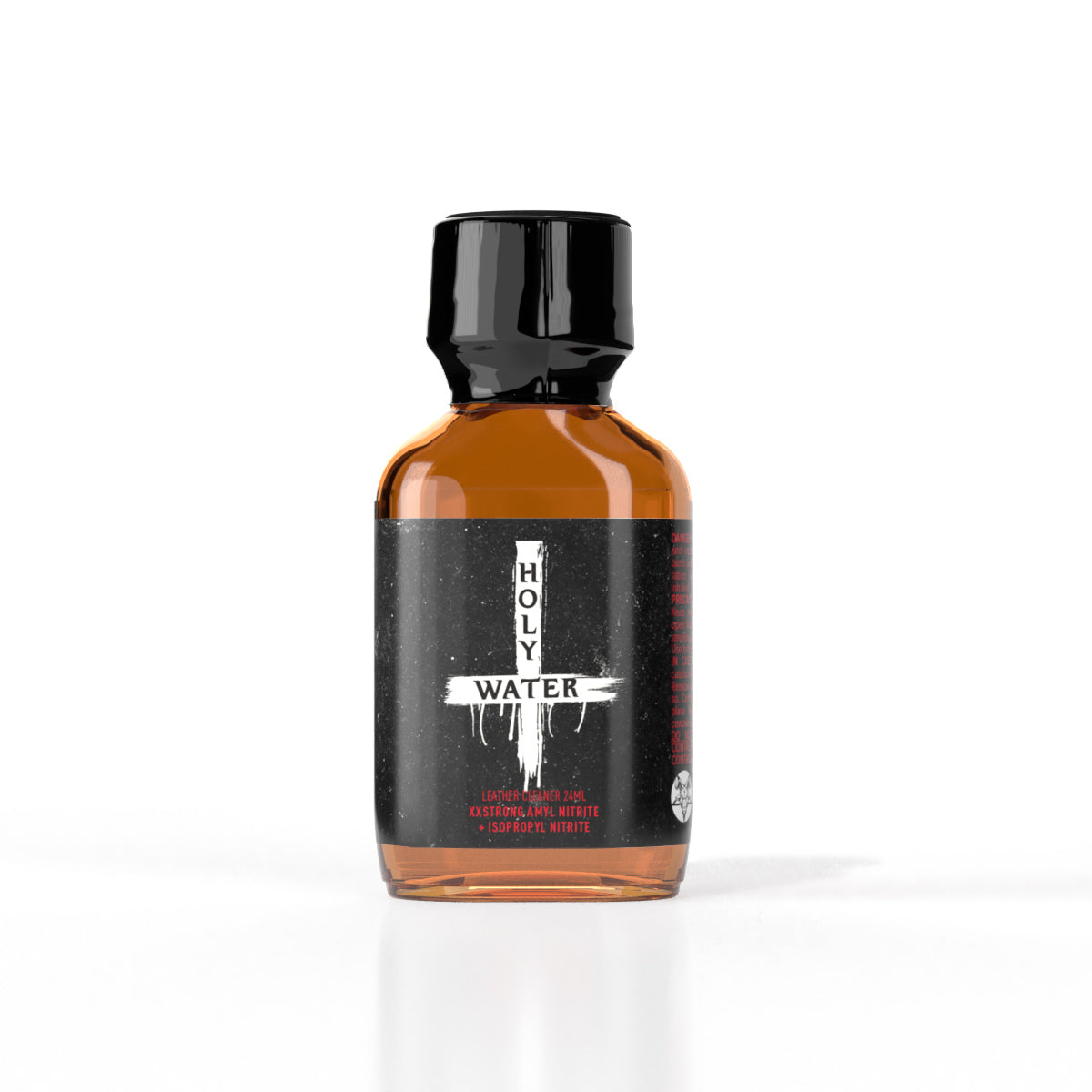
Holy Water
- Formula : Propyl nitrite + amyl nitrite
- Sizes : 10 ml · 24 ml
- Compliance : CLP compliant, child safety cap included
- Strength : ★★★★☆
USA Poppers is published by PWD Factory, a poppers manufacturer. We do not sell anything on this site: the "Buy" button leads to twistedbeastpoppers.com, an independent retailer. That link is a commercial link. Product information comes from the manufacturer's own data.
The Holy Water range is one of the most talked about names among room odorizer and specialty solvent cleaner collectors in the United States. Sold strictly as a leather cleaner, room odorizer and solvent cleaning product, Holy Water has built a reputation for consistent formulation, distinctive packaging and a name that has become instantly recognizable on retailer shelves and in private collections alike.
This page covers the range in full: what the name means, the solvent family it belongs to, how the bottles are built and capped, how the article should be stored as a flammable chemical product, how long it lasts once opened, how to recognize a genuine bottle, and how it compares with other ranges. As with every product on this site, Holy Water is intended strictly as a cleaning and odorizing article. It is not for human consumption and is sold to adults only.
What Holy Water is and where the name comes from
The name Holy Water plays on the idea of a small, almost ceremonial bottle: compact, clear, and treated with a certain reverence by the people who collect and display it. Retailers who have carried the label for years describe it as one of the steadier names in the category, a range that built its following less through novelty and more through repeat customers who came to trust the label's consistency from batch to batch.
Among collectors, Holy Water sits alongside other long-running names as a kind of benchmark. Shop owners who have stocked specialty solvent cleaners for years will often point to Holy Water as one of the labels that helped define what buyers expect from this category: a clean presentation, a formulation that behaves predictably in storage, and packaging that has stayed recognizable even as the label has been refreshed over time. That reputation is part of why the range remains a frequent request from customers who already know what they are looking for by name.
The solvent formulation family
Every range in our catalogue belongs to a particular solvent formulation family, and this is one of the main things that separates one label from another beyond packaging. Holy Water is built around a specific alkyl nitrite solvent chemistry that gives it its characteristic scent profile and evaporation behavior, distinct from ranges built on a different alkyl chain or blend. Buyers who compare labels side by side will notice differences in how quickly a bottle's contents evaporate once opened, how the scent reads in a room, and how the liquid behaves in cooler versus warmer storage conditions.
Because these are volatile solvent products, the formulation family also affects handling advice. Holy Water, like other ranges in the same chemistry family, is formulated to be used as a room odorizer and cleaning solvent in a well ventilated space, kept away from anything that could ignite it. Buyers choosing between ranges should think of the formulation family the way they would think of any specialty cleaning solvent: each family has its own profile, and Holy Water's has earned its following for being consistent across the batches we have handled.
Bottle formats, cap design and storage requirements
Holy Water is typically offered in small glass bottle formats designed for durability and controlled dispensing. The cap is built with a secure sealing mechanism intended to keep the bottle closed tightly between uses, which matters both for retaining the solvent's strength and for safe handling of a flammable liquid. Because the product is a chemical article, correct storage is not optional. The bottle should always be kept upright, in a cool location, away from direct light and away from any source of heat. The cap should remain closed whenever the bottle is not actively being used, and the article must be kept well away from open flame or any ignition source, since the liquid inside is flammable.
These storage rules apply to every bottle in the Holy Water range regardless of format, and they are consistent with how any specialty solvent cleaner should be treated in a home or storage area. A cool, dark cabinet away from stovetops, heaters or direct sun exposure is the simplest way to protect both the bottle and whoever else shares the space where it is stored.
Shelf life, unopened and opened
An unopened bottle of Holy Water, stored correctly upright and away from heat and light, will generally hold its formulation well over a longer period than a bottle that has already been opened. Once a bottle is opened, the solvent begins a slower process of degradation as it is exposed to air each time the cap is removed, which is why an opened bottle has a shorter practical shelf life than an unopened one. Keeping the cap tightly closed between uses, avoiding heat exposure, and never leaving the bottle open unnecessarily are the best ways to preserve the product's strength and scent for as long as possible once it has been opened.
How to spot a genuine bottle
Because Holy Water is a well known name, it has also attracted counterfeit versions over the years, and knowing how to tell a genuine bottle from a fake matters for both quality and safety. A genuine Holy Water bottle carries a crisp, high quality label print with sharp text and consistent color, without blurred edges or mismatched fonts. The cap seal should be intact and show no sign of having been tampered with or re-glued before it reaches you. Genuine bottles also carry clear batch marking printed cleanly on the label or base, which counterfeit versions often reproduce poorly or omit altogether. If a bottle arrives with a smudged label, a loose or damaged cap seal, or no legible batch information, it should be treated with suspicion regardless of where it was purchased.
Choosing between ranges
For buyers comparing ranges in our catalogue, Holy Water tends to appeal to those who already know the label by reputation and want a consistent, well established option rather than a newer or more experimental formulation. Other ranges we carry may use a different solvent family, a different bottle format, or a different scent profile, so the right choice often comes down to personal familiarity and what a buyer's collection already includes. We are always happy to talk through how the ranges differ so customers can make an informed choice.
Q: Is Holy Water safe to store at home like other household chemicals?
A: Store it upright, in a cool spot away from light and heat, with the cap fully closed and kept well away from open flame, exactly as you would store any flammable solvent cleaner.
Q: Can I tell how old an opened bottle is?
A: Batch marking on the label can help identify when a bottle was produced, but once opened, the practical shelf life depends more on storage conditions than on the date alone, so keeping the cap closed and the bottle cool matters most.
Q: Is this product intended for personal use on the body?
A: No. Holy Water is sold strictly as a room odorizer and specialty solvent cleaner and is not for human consumption.